

(C) Luo-chu Yang
2026.08.13
Artificial hibernation reveals secrets of long-term memory
Challenging long-held assumptions on how memory works, scientists uncover the importance of engram architecture to long-term memory retention.
Professor Kazumasa Tanaka and Dr. Yu-Ju Lin of the Memory Research Unit at the Okinawa Institute of Science and Technology (OIST), together with Professor Takeshi Sakurai of the International Institute for Integrative Sleep Medicine (WPI-IIIS), University of Tsukuba, the Exploratory Research Center on Life and Living Systems (ExCELLS) and the National Institute for Physiological Sciences, have shown using artificial hibernation that long-term memory retention depends not on the strength of individual synapses but on the spatial architecture of the synapses that carry the memory trace, or engram.
Memories are stored in the brain as physical traces called engrams. For decades, synaptic potentiation — the strengthening of connections and the enlargement of dendritic spines — has been considered the key to retaining them.
In this study, the team applied the artificial hibernation technique that Professor Sakurai’s group first established in mice in 2020, imaging the brain before, during and after hibernation. More than half of the synapses in the hippocampus were lost and neuronal firing rates fell by roughly 70%, with synapse elimination occurring regardless of dendritic spine size. Yet in behavioral tests, the animals’ memory recall was unimpaired and in some cases even improved.
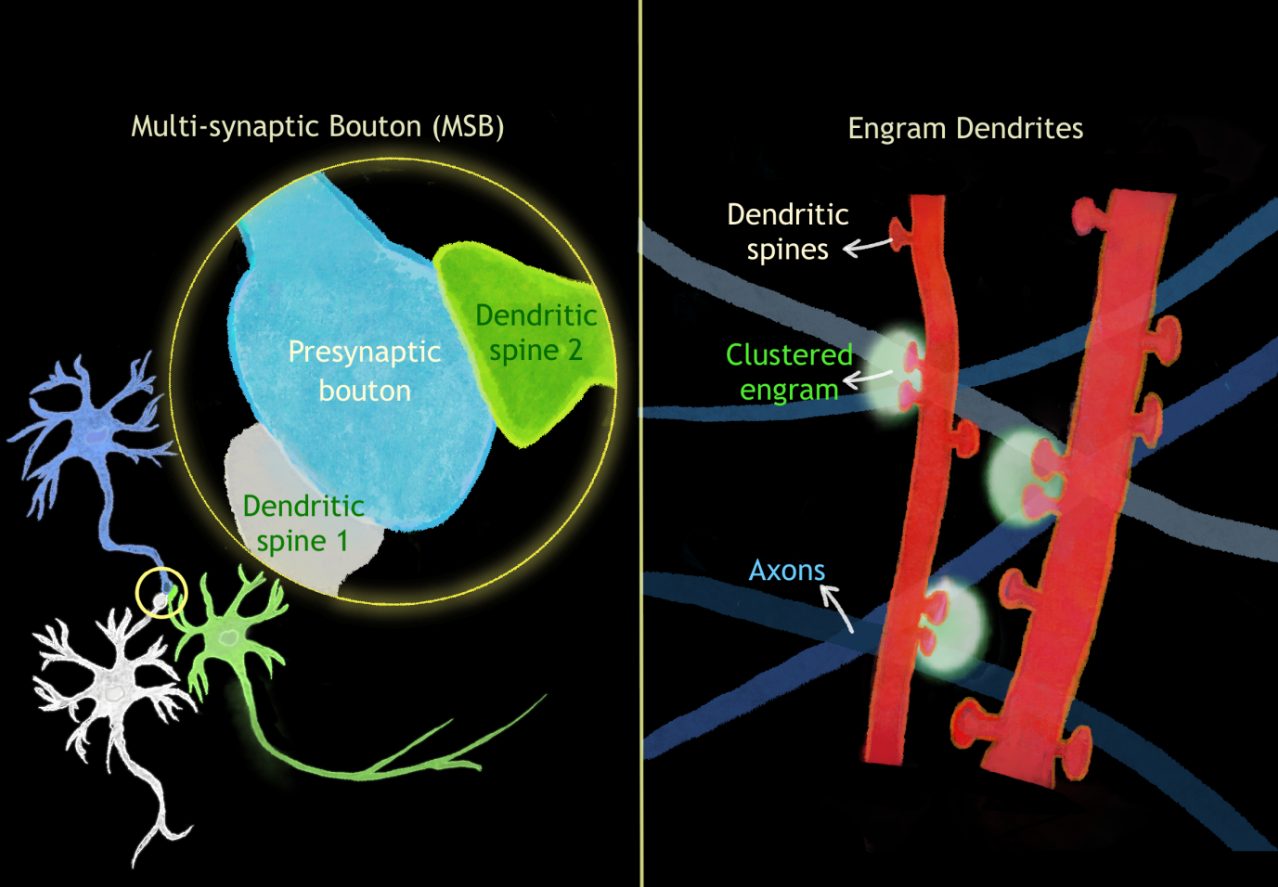
To explain this, the researchers became the first to apply correlative light and electron microscopy (CLEM) to the observation of engrams. They found that multi-synaptic boutons (MSBs), in which a single presynaptic terminal contacts multiple dendritic spines, and clustered engram synapses activated in close proximity to one another, were selectively preserved through hibernation. The findings suggest that only particular clusters of synapses are required for long-term memory, and that the rest may be dispensable.
Because the neural circuitry underlying hibernation is well conserved across mammals, including humans, research using artificial hibernation may yield insights and applications relevant to human health and neuroscience.
These results were published in the journal Science, issued by the American Association for the Advancement of Science.
| Press release | |
|---|---|
| Paper | |